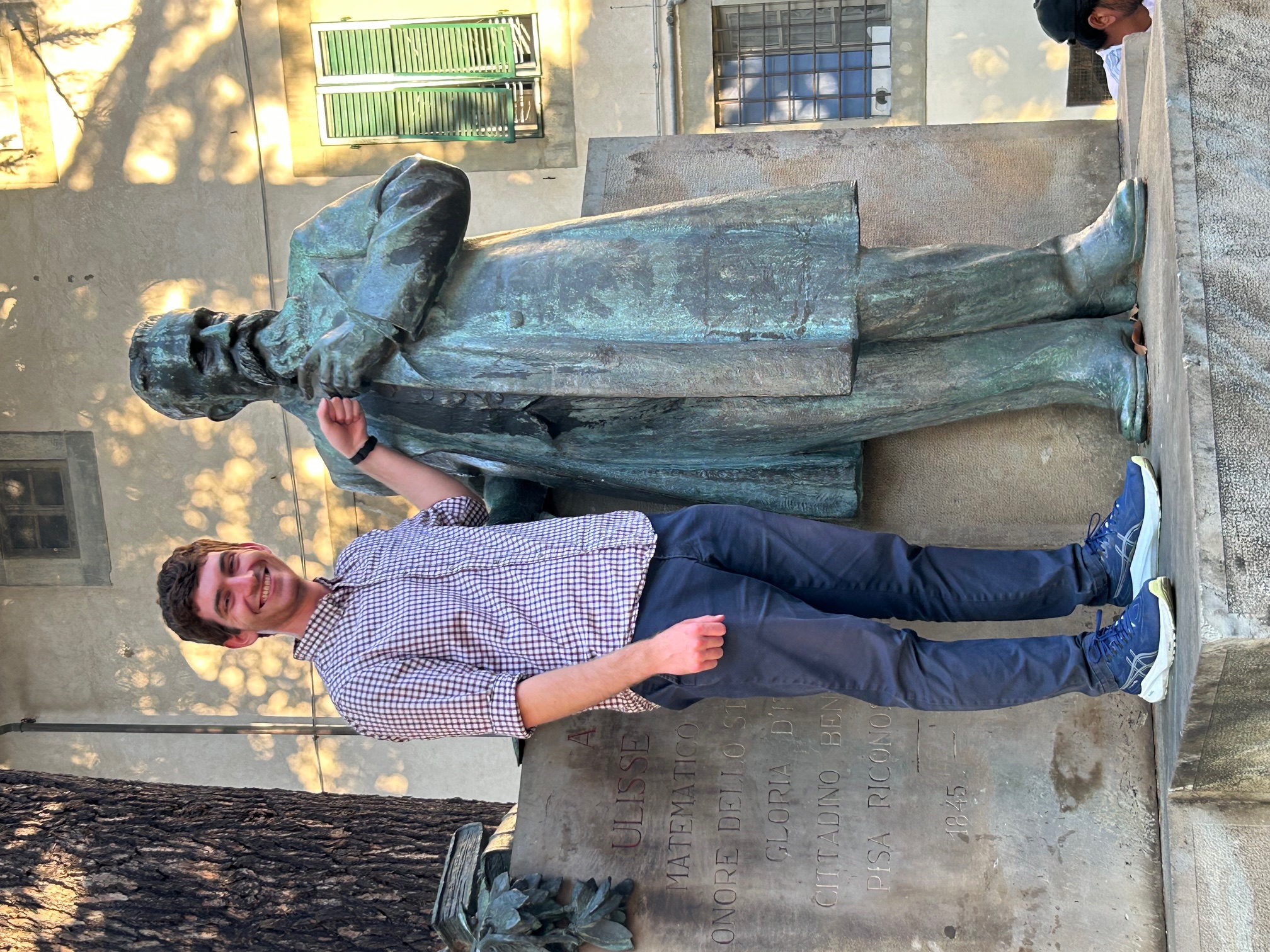
Tips for High School Math Students
This page is for high school students who are interested in some tips about how to explore mathematics, especially numerical analysis, machine learning, and mathematical modeling. Any links included are working as of the date of posting (March 2026).
General Advice
I would generally advise exploring many areas of math and science before focusing attention on one particular area. Math is a much broader field than most people imagine, and they are all connected in interesting ways. I will simply list some areas of math:
- Foundations of Mathematics: Set theory, mathematical logic, proof theory, category theory, etc.
- Pure Mathematics: Number theory, abstract algebra, differential geometry, topology, etc.
- Applied Mathematics: Numerical analysis, partial differential equations, mathematical physics, quantum computing, machine learning theory, etc.
Some of these distinctions are actually quite blurry. You may find that if you get interested in the philosophy of mathematics, all of these areas might become more interesting as a unified whole, but foundations of mathematics will become particularly interesting. If you like the beauty and experience of a mathematical proof, perhaps pure math might be the direction you take. Applied math is great for making connections to the physical world (in this way, it can also be interesting philosophically). I would also encourage learning a good amount of physics or another science which you find interesting. Being able to connect different areas of knowledge is the mark of a good thinker. I would encourage choosing a college not for a single particular area of mathematics that you’re interested in–you can always go into more depth in a PhD program. Choose a program that will help you connect the dots with how the world works by exploring more than one area of math and science.
Lastly, here’s a disclaimer about high school math. Most high school students do not learn what math is really all about. Math primarily works through reasoning and proofs. Many high schools neglect this most important aspect of math and instead teach how to compute and manipulate equations (and do not always explain why these manipulations are valid). Math is much more fun than that, and I would encourage reading an introductory text on mathematical proofs (see below) to get a sense of what math really is.
Below I’ve included some links to resources which might be helpful to explore different ideas in math and computer science already in high school.
Some Resources
Free Online Course Material
A really great way to explore topics that you can’t study in your school is to either read many Wikipedia pages or to find free course material from colleges online. Here are some really great resources:
- MIT OpenCourseWare: Artificial Intelligence with Patrick Winston, Linear Algebra with Gilbert Strang, etc.
- Carnegie Mellon University Modern AI Course
- Python Like You Mean It: Free online resource for learning Python and NumPy
Mathematical Modeling Competitions
Peparing for and partaking in a mathematical modeling competition can be a fun way to learn how to approach developing or applying mathematics to solve a concrete problem. Reading the top solutions of previous years can be helpful to understand principles like accounting for various sources of error and checking model sensitivity. This can be a neat way to learn certain applied math research skills without yet diving into cutting edge research requiring mathematical ideas far past the high school level. I would suggest forming a club around preparing for some of these competitions with a faculty mentor who can serve as the coach of the team.
- HiMCM: High School Mathematical Contest in Modeling
- MCM: Mathematical Contest in Modeling
- MathWorks Math Modeling Challenge (M3 Challenge)
In addition to mathematical modeling competitions, there are also more traditional math contests like the AMC, AIME, etc.
Summer Math Camps
I know that there exist summer math and computer science camps, including some online options. Here are just a few:
- Beaver Works Summer Institute at MIT: both online and in-person options
- iD Tech
- Summer course at local college
Things to Read
- Art of Problem Solving Textbook Series: Art of Problem solving has a lot of other great resources for learning contest math and mathematical reasoning.
- Mathematical Thinking: Problem-solving and Proofs by D’Angelo and West (or any other introduction to proofs)